
Some time ago I was asked by a Dealer how the Zeus and standard Linn 110V AC synchronous motor performs against a Lingo 4 and its 12v AC synchronous motor. Both Linn and Rega have in recent years switched to 12v and 24v AC motors respectively.
As there seemed to be lots of opinions and very little data, I decided to run vibration measurements on various configurations and the article below documents the findings.
The vibration measurements were made using a three axis vibration monitor, a RIGOL MSO5704 scope in FFT mode. Each motor was mounted in the same jig under the same mounting conditions, with the sensor mounted in the same position on each motor.
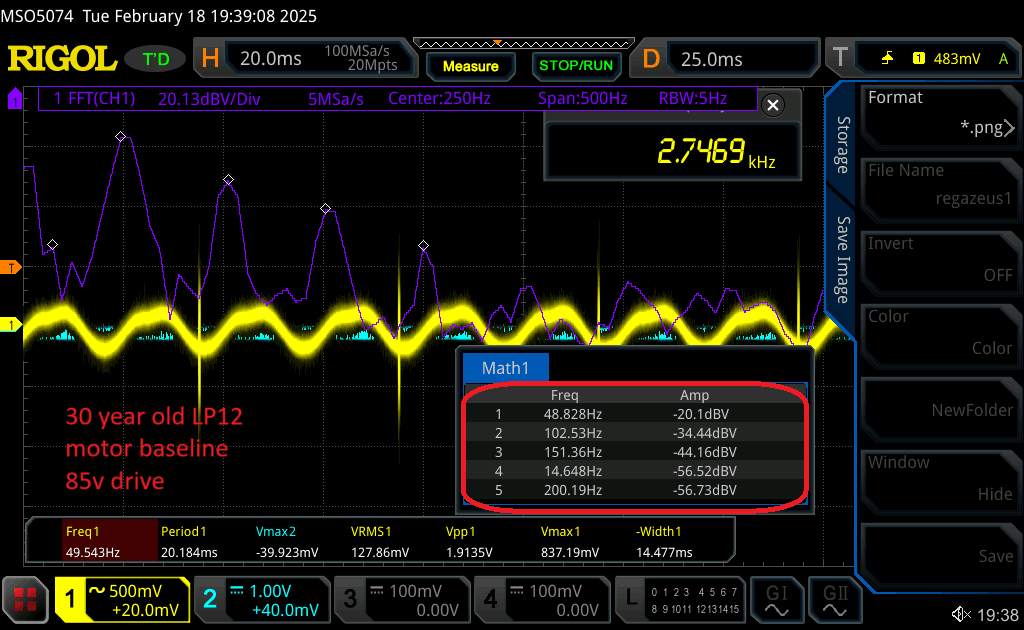
The baseline shown in Figure 1 was a 30 year old LP12 motor connected to a recently serviced Linn Valhalla PSU to give the best possible conditions. The drive voltage to the motor was 84v, which is the recommended setting for the Valhalla. In a Valhalla, the phase angle between the RED and BLUE motor windings is derived from a fixed capacitor that tends not to be the ideal value. It can be seen from the purple FFT trace that there are vibration peaks at the fundamental 50Hz @ -20.1 dBV, 2nd harmonic 102 Hz @ -34.44 dBV and so on for third and fourth harmonics. The smaller (more -ve) the dBV figure for each harmonic, the better i.e. less vibration.
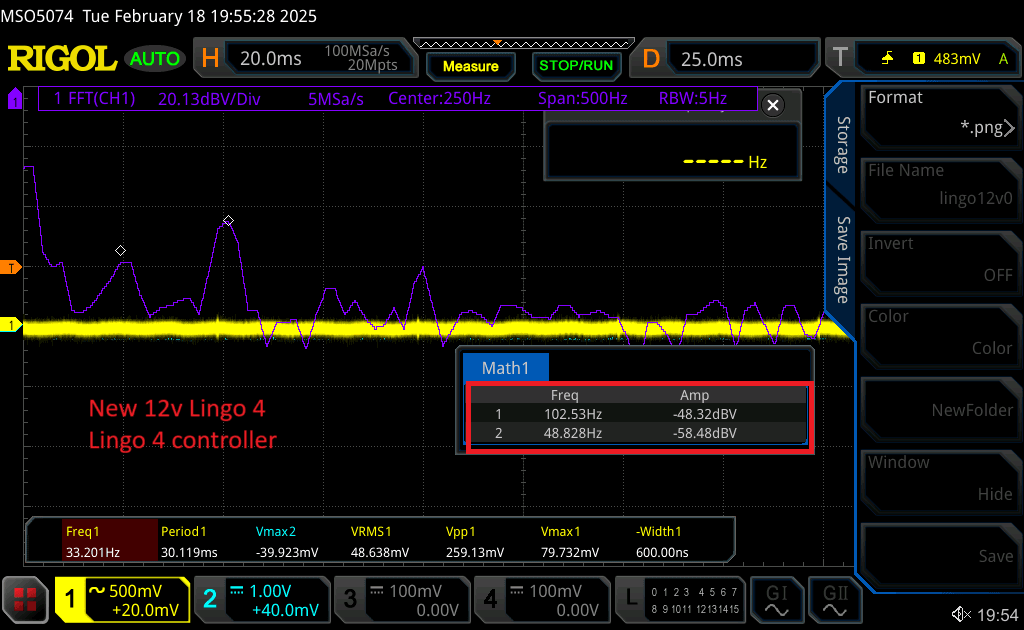
Repeating the test for a new Lingo 4 and new 12V-rated AC motor driven at 6.8v we can see a vast improvement over the Valhalla configuration. Figure 2. This is one of the reasons why a Lingo 4 outperforms a Valhalla PSU.
48.82Hz @ -58.48 dBV and 102.5Hz @ -48.32 dBV (note the differing order. This means the strongest vibration is the second harmonic).
Now lets take the same 30-year-old LP12 motor that was tested with the Valhalla and try it on a Zeus PSU 110v rated motor driven at 60v 92 degree phase angle, driven by Zeus. Why 92 degrees, you may ask? Because the Zeus is able to vary the phase angle between the RED and BLUE motor windings electronically rather than it being fixed in the Valhalla or Lingo. Figure 3. You can clearly see purple vibration peaks the 102.5 HZ @ -52.6 dBV and 48.82 Hz @ 54.89 dBV.
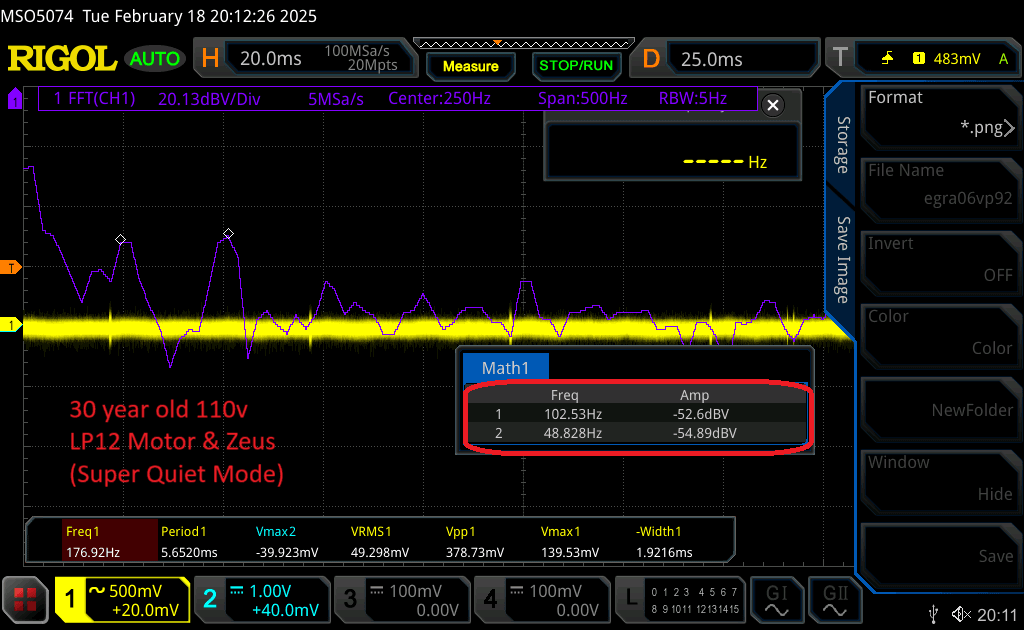
Less vibration than the Lingo 4 at the fundamental but slightly more on the second harmonic. But wait, it is a 30 year old motor after all. I think given another 20-30 minutes of tuning the phase angle I could have gotten the second harmonic better.
In Conclusion
The Zeus can drive original 110v LP12 motors to similar performance levels as Lingo 4 with their new 12v AC Synchronous motors, but at a fraction of the price. So why are the newer low-voltage AC synchronous motors promoted so heavily (by Rega in particular) as being low vibration? The answer lies not in the motor; yes, it will have the advantage of being new so hopefully the bearings are better. However, the real reason lies in the cost of manufacturing the PSU electronics. You see, manufacturing low voltage high current PSU’s is cheaper and easier to do than high-voltage low-current drive PSUs. Rega can do their phase adjustments by using low-voltage variable capacitor trim pots (which tend to drift with heat and vibration). Vibration performance actually has little to do with the motor (providing bearings are in reasonable condition).
Most 12v, 24v and 110v motors share a common construction. The difference is the gauge of the wire used in the coils. Lower voltage motors use thicker wire and need higher drive currents to maintain similar flux ratios across the rotors. How do we know? We disassemble and repair motors. (Also, look at the motor datasheets).
You can gain similar performance with Zeus and Minos controllers with original 110V AC synchronous motors. Do not be fooled by hyperbole, conjecture, marketing and hype.
This quote, made by W. Edwards Deming should guide us more frequently in the HiFi world: ”In God we trust. All others must bring data.” 😊
Data Summary Table
Motor | Fundimental 50Hz peak | 2nd Harmonic 100Hz peak | Notes |
110v LP12 motor (30 year old) powered by newly refurbished Valhalla | -20.1 dBV | -34.44 dBV | Baseline |
110v LP12 motor (30 year old) Zeus. Drop voltage full speed 92 deg phase (optimized) | -54.89 dBV | -52.6 dBV | Lower numbers are better. Far superior performance over Valhalla. |
12v Lingo 4 motor on Lingo 4 (optimized) new | -58 dbV | -48.32 dBV | Zeus outperforms Lingo 4 at fundamental but slightly higher 2nd Harmonic. |